

How to Pick the Best EHS Software for Your Needs
If you’re thinking about deploying Environmental, Health, and Safety (EHS) software in your company, evaluating the vast landscape of options can be daunting to say the least. The resources available to help you make your decision are seemingly endless, from top 10 EHS software lists to vendor reports, industry articles, and product demonstrations. This article serves as a comprehensive guide to choosing the best EHS software for your organization.
The real question is, how can you use this information to find the best EHS software for your company?
In this article, we provide an overview of the evaluation process and how to choose a solution that’s truly fit for purpose. We’ll examine different types of EHS software, the steps in the selection process, and how to use a quantitative approach to finding the best fit.
Decoding the Vendor Landscape: Best-of-Breed vs. EHS Suite Solutions
Almost every EHS software company started by solving a single problem. Over time, some vendors retain that focus and aim product updates at serving that niche.
Other vendors diversify into a full EHS suite, adding other modules covering a wide range of EHS processes such as audit management, compliance management, incident tracking, and ESG reporting.
As for which type is best for your organization, it depends on your needs and future plans.
Some companies opt for an integrated suite as part of a plan to scale EHS process digitization over time. For instance, a company may start with one solution, such as permit management, later linking it with additional processes such as audit management and task management.
Conversely, other companies with highly specialized requirements around certain EHS processes may choose to link together multiple best-of-breed solutions from different vendors. This approach is becoming more common with the ability to seamlessly link software systems together using application programming interfaces (APIs), ensuring compatibility and integration with existing systems such as ERP or HR platforms, and providing advanced functionality alongside integrated reporting and tracking.
Common Drivers of EHS Software Adoption
The best EHS software for your company will depend largely on what’s behind the push for implementation. Common drivers of EHS software adoption include the need to:
- Prevent costly compliance incidents
- Simplify compliance management
- Streamline EHS reporting
- Establish a credible corporate sustainability program
- Improve efficiency
- Support a culture of safety
- Achieve safer operations
- Enhance operational efficiency
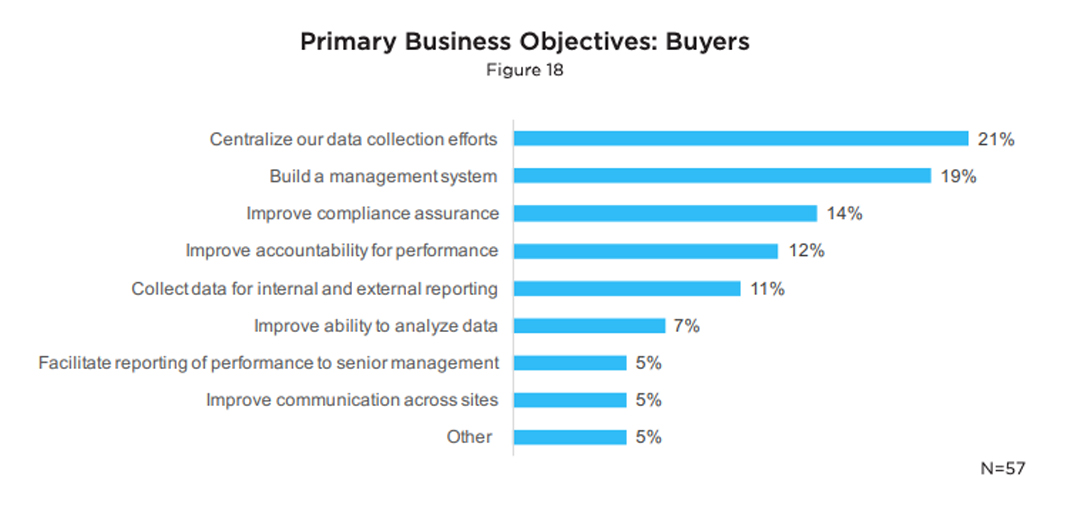
The National Association for Environmental Management’s (NAEM) EHS & Sustainability Software Buyer’s Guide also distinguished between First Time Buyers and Past Purchasers with slightly different objectives for each. The following chart shows the Primary Business Objectives of First Time Buyers.
Steps in the EHS Software Selection Process
EHS software selection is a complex process involving multiple stakeholder groups. The following steps will help you identify the key factors to consider when selecting EHS software. Below, we break this process down into seven steps aimed at helping you think beyond the top 10 lists to find a system that meets your business needs.
1. Determine Your Goals
Step one is establishing your overall goals for your corporate EHS system. This relates to the adoption drivers discussed above and the problem you’re trying to solve. When determining your goals, it is important to consider your organization’s unique needs and challenges to ensure the EHS system aligns with your specific requirements.
For instance, are you looking to standardize multiple EHS processes, or are you looking for deep functionality in a particular function such as permit management? Determining your goals upfront is crucial to defining and prioritizing your system requirements, building the business case, and communicating the project’s value to stakeholders.
Consulting with EHS professionals can help clarify your requirements and ensure all relevant challenges specific to your organization are addressed.
2. Secure Leadership Buy-In
Leadership commitment is essential to securing funding and resources for software implementation. If you don’t have leadership buy-in, your job is to first build the business case to get approval for the project.
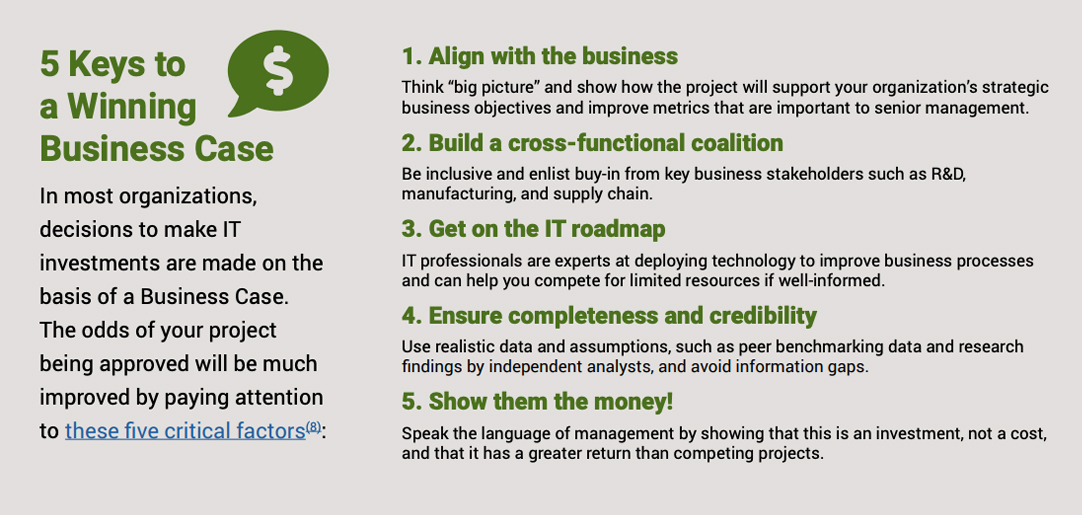
Your business case should cover the ROI of EHS software, including the potential for cost effectiveness by balancing functionality, scalability, and vendor reputation to ensure long-term value and operational efficiency. This includes:
- Avoidance of OSHA fines and penalties
- Reduction in total recordable incident rate (TRIR)
- Lower workers’ compensation costs
Note that small reductions in TRIR can have a comparatively large impact on injury costs overall. Let’s say, for example, your company has 1,000 employees and a TRIR of 2.9. Using the average cost of a workplace injury ($100,000), reducing TRIR by 20% would deliver a savings of $580,000 annually.
3. Prioritize Critical Features
Next, you’ll want to identify the most critical requirements, capabilities, and features you’re looking for in a solution. While these will be different for all organizations, there are common modules that are considered critical for an EHS management system.
Key features and modules in the best EHS software to prioritize include:
- Compliance features: compliance tracking, compliance workflows, audit trails, regulatory reporting, regulatory standards, regulatory requirements, compliance tasks, and ensure compliance. These should all help with risk management.
- Safety features: incident reporting, risk assessments, safety hazards, safety risks, risk management, potential hazards, potential risks, safety training, safety practices, workplace safety, corrective action, corrective actions, analyze incidents, trend analysis, and training management.
- Environmental features: chemical management, chemical inventories, safety data sheets, waste management, environmental compliance, and environmental responsibility.
- Usability features: user friendly interface, intuitive interface, mobile apps, digital solution, reducing manual effort, manual effort, manual data entry, and flexible analytics and reporting.
- Training and records: training records, training management, and audit trails for maintaining compliance and verifying staff competency.
- Risk and operational management: risk management, operational excellence, and modules that help minimize risks, reduce risk, and protect employees.
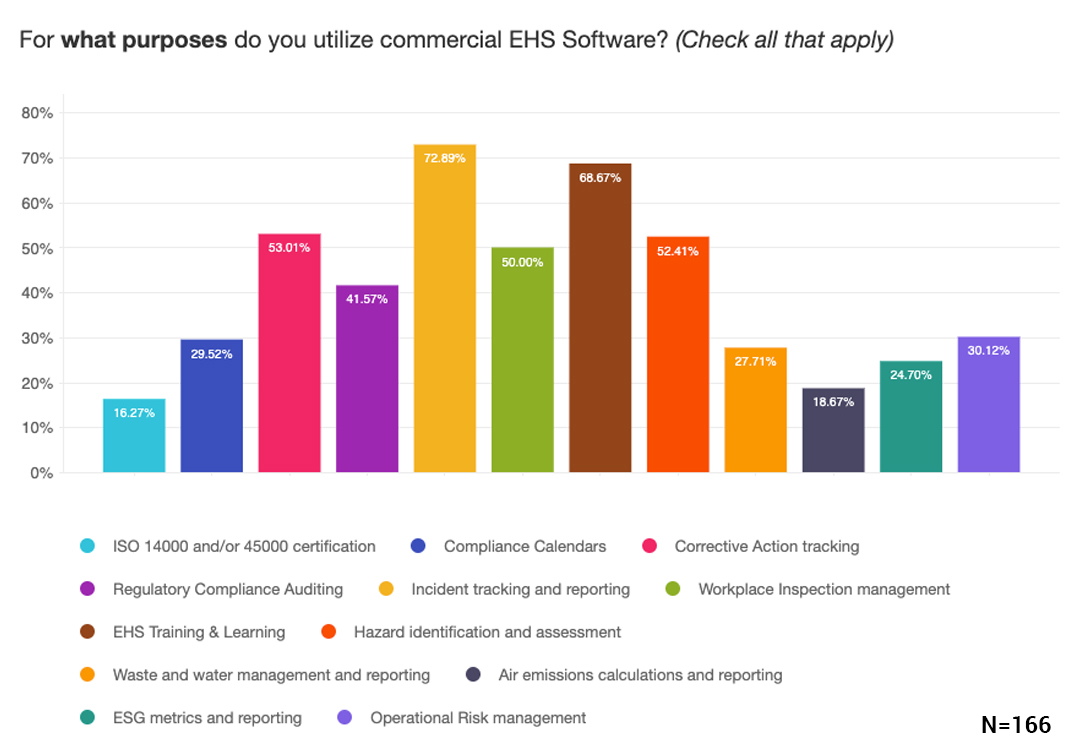
Below is a chart showing results from Dakota Software’s 2024 EHS Technology Trends survey. Incident, Training & Learning, Hazard Assessment, Inspection, and Regulatory Compliance Audit Management were listed as the most utilized EHS software applications.
When asked the question “What applications absolutely must be part of an EHS software platform?” respondents chose similar products, with Compliance Calendar and SDS Management rounding out the top 7.
When asked which EHS Software features were the most important, respondents listed Data Security, Intuitive User Interface, and Flexible Analytics and Reporting at the top. Also listed were the inclusion of EHS Regulatory Content and a Mobile-Optimized Users Experience.
4. Create a Weighted Scorecard
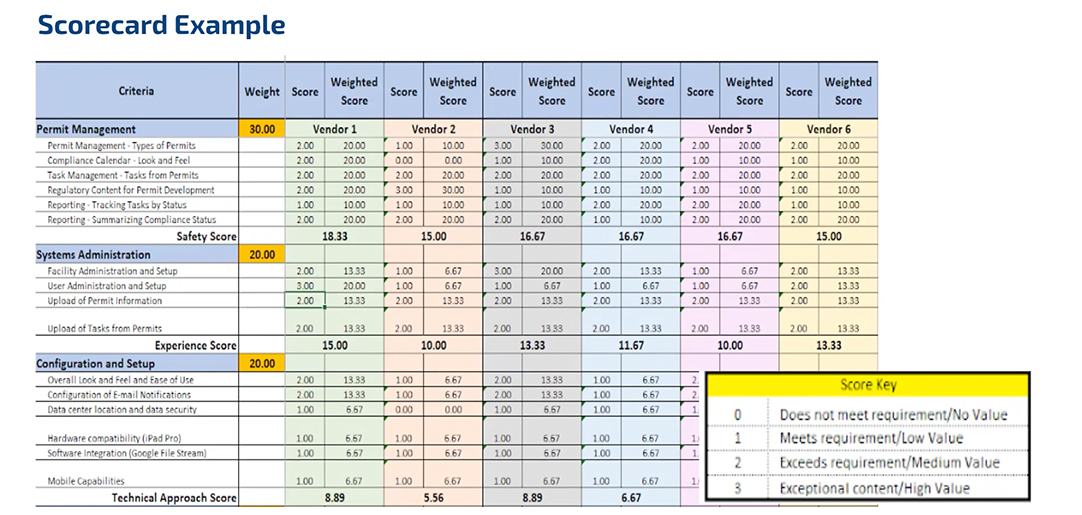
A weighted scorecard based on your requirements provides a quantitative approach to evaluating different EHS software options. The scorecard may incorporate your priority features from step three, plus any additional decision-making criteria. Each category should be weighted according to its relative importance, for example:
- Permit management: 30%
- EHS and ESG reporting : 20%
- Ease of administration and setup: 20%
- Pricing and license structure: 20%
- Industry subject matter expertise: 10%
Each category may be broken down into more detailed criteria. For instance, permit management may look at types of permits, compliance calendars, task management, and regulatory content updates. An example scorecard from the webinar Strategies for Successful EHS & ESG Software Implementation is shown below.
5. Identify Potential Solutions
Once you’ve defined your decision-making criteria, it’s time to create a shortlist of vendors and assess each using the scorecard created in the previous step. Resources for identifying potential vendors include:
- Review sites such as Capterra or G2
- Industry analyst groups like Verdantix and Gartner
- Member organizations such as the National Association of Environmental Managers (NAEM) or National Safety Council (NSC)
- Referrals from consultants, peers, and trusted colleagues who have first-hand experience with EHS software solutions
- Vendor resources such as EHS Buyer’s Guides
Organizations operating in regulated industries should pay special attention to vendors with experience meeting industry-specific compliance requirements, as these sectors often face unique regulatory standards and operational challenges.
At this point, some companies elect to go through a request for proposal (RFP) process. While an RFP can be useful when comparing similar solutions, you have to be careful that you’re not comparing apples to oranges. Also, know that an RFP can delay the selection process significantly or even grind it to a halt when teams get bogged down in the details of responses.
6. Request Demos
After you have your shortlist of potential vendors, the next step is to schedule product demonstrations. You’ll get the most value from these sessions if you come prepared with questions relating back to your core requirements and decision-making criteria.
As you view the demonstrations, it’s also important to avoid getting distracted by bells and whistles. Instead, stay focused on your core requirements and gathering details for your platform scorecard.
7. Select Your EHS Software Platform
By this point, your team should be equipped with the information to choose the best solution for your organization. Selecting the right software, and specifically the right EHS software, is essential to ensure alignment with your organizational needs, enhance safety, ensure compliance, and support your long-term success. Here, you’ll want to refer back to your scorecard from step four, while also paying special attention to areas such as:
- How easy the software is to use, for example whether it includes guided walk-throughs so users can learn the system at their own pace
- Whether the software can be accessed from any type of mobile device, with simplified options like single sign-on (SSO)
- Whether it’s scalable to meet your future needs, and any additional costs associated with adding users or increased data usage
- How long implementation will take
- Whether it can be customized and/or configured, recognizing that customization can increase project costs
- How regulatory content is maintained and whether the system provides automatic updates
Ensuring a Smooth EHS Software Rollout
Choosing the best EHS software for your organization is just the beginning. That’s why it’s essential to partner with a vendor who will ensure you have a tailored implementation plan to help ensure the system delivers on your goals after you go live.
The deployment process itself can take many forms depending on your business structure and rollout strategy. For instance, you may start by piloting the software at one site, then rolling it out across locations once you have the process down. It’s also common to start by deploying a single process, for example incident management, then integrating other processes such as compliance calendars or audit programs individually over time.
No matter where you are in the software selection process, keep in mind that “best” is a subjective term. As you sift through advice and resources, remember that while top 10 EHS software lists are a starting point, they don’t tell the whole story. It’s only by making your goals and requirements your guiding star that you can truly find the best EHS software for your organization.
If you’re currently in the market for EHS software, you should consider evaluating Dakota Software against your fit-for-purpose criteria. Request a demo to learn how our solutions can help you ensure bulletproof EHS compliance and create a strong foundation of EHS management excellence.