Across the country, organizations that embrace safety audits as part of a proactive safety program consistently report fewer injuries, lower workers’ compensation costs, and safer, more engaged workplaces.
At a national level, overall workplace safety trends reflect improvements. The total nonfatal work injury and illness rates in the private industry have seen a decline, decreasing from 2.8 cases per 100 full-time workers in 2019 to 2.4 in 2023. Fatal work injuries have also decreased, from 5,486 in 2022 to 5,283 in 2023.
But not all findings are as clear-cut. In Alberta, Canada, inspections in the construction sector actually correlated with a 12% rise in reported injuries during the first year post-audit, possibly due to better reporting or transitional disruption. The takeaway? A safety audit alone won’t reduce risk unless it’s part of a larger commitment to improvement. Real impact comes when audits are paired with leadership follow-through, root cause analysis, and a culture where workers feel empowered to speak up and act safely.
In this article, we’ll explore how to run a successful workplace safety audit that goes beyond box-checking and becomes a catalyst for lasting change. You’ll learn how to design your audits, choose the right tools, train your team, and use findings to build a safer, more resilient organization. Because when audits are done right, they don’t just reduce incidents—they change culture.
What Is a Safety Audit?
 A safety audit is a structured, in-depth evaluation of an organization’s health and safety systems. Its purpose is to verify compliance with internal procedures and external regulations like those outlined by OSHA and standards like ISO 45001, assess the effectiveness of controls, and identify opportunities for improvement. Unlike routine inspections or hazard assessments, a safety audit examines whether safety management programs are working as intended, on paper and in practice.
Safety audits support continuous improvement, reinforce accountability, and help organizations maintain safe working conditions for employees.
Types of Safety Audits and Their Purposes
 Safety audits come in several forms, each playing a unique role in a comprehensive safety management program. Each audit type brings unique value—from verifying compliance to assessing system-wide performance. By incorporating a mix of audit types and methods, organizations can identify risks more effectively and continuously improve their safety culture.
- Compliance Audits
- Purpose: Verify adherence to legal requirements and industry standards (e.g., OSHA regulations).
- Focus: Identifying gaps in compliance programs by systematically reviewing policies, procedures, documentation, and physical conditions. Audits often include interviews with employees to assess their understanding of protocols and evaluate how well safety and compliance practices are being applied in the field.
- Outcome: Helps organizations avoid fines and maintain regulatory standing.
- Program Audits
- Purpose: Assess the effectiveness of specific safety initiatives.
- Examples:
- Lockout/Tagout (LOTO) procedures
- Confined space entry protocols
- Hazard communication programs
- Outcome: Provides focused insight into targeted risk areas.
- Management System Audits
- Purpose: Evaluate whether the organization’s entire Safety Management System (SMS) aligns with recognized standards such as ISO 45001 or ANSI Z10.
- Scope: Holistic and strategic, examining policies, procedures, training, and performance metrics.
Audit Methods: Internal vs. External
Internal (Self) Audits
- Conducted by: Corporate EHS teams, In-house safety teams or compliance personnel.
- Frequency: Weekly, quarterly, or annually, depending on scope.
- Benefits:
- Greater control and flexibility
- Secure cloud-based data storage
- Customizable access for authorized staff
External Audits
- Conducted by: consulting firms, certification organizations, or third-party compliance agencies.
- Purpose: Provide unbiased evaluations and reduce internal workload.
- Regulatory Agencies That Conduct External Audits:
- OSHA (Occupational Safety and Health Administration)
- MSHA (Mine Safety and Health Administration)
- FMCSA (Federal Motor Carrier Safety Administration)
- EPA (Environmental Protection Agency)
Safety Audits vs. Inspections vs. Risk Assessments
These three processes often get lumped together, but they serve distinct purposes in an effective safety management system:
| Safety Audit | Safety Inspection | Risk Assessment | |
| Purpose | Evaluate system effectiveness and compliance | Identify hazards and unsafe conditions | Analyze risks and determine preventive controls |
| Scope | Broad and process-based | Visual, task- or area-specific | Hazard- or task-specific |
| Frequency | Periodic (e.g., quarterly or annually) | Frequent (daily to monthly) | As needed or during job/task planning |
| Conducted By | EHS teams, third parties, or corporate audit | Supervisors or EHS staff | EHS professionals, with frontline input |
| Output | Findings, corrective actions, compliance score | Checklists and observations | Risk ratings and mitigation measures |
In a nutshell, inspections are visual and often checklist-based, focusing on conditions like checking for blocked exits, faulty equipment, or missing PPE. Risk assessments go a step further by evaluating the probability and severity of harm from specific hazards, helping to prioritize mitigation efforts.
Safety audits, however, are more holistic and strategic. They examine whether your entire safety program, including policies, training programs, and compliance calendars, is functioning as intended.
Who Conducts the Safety Audit Procedure?
Safety audits can be conducted by different stakeholders depending on the organization’s size, maturity, and regulatory obligations:
- Internal EHS Teams: In-house safety professionals often lead audits as part of routine EHS program oversight. Also known as self-assessments, this approach allows site staff to leverage their deep understanding of facility operations to surface both compliance issues and culture gaps.
- Third-Party Consultants: External auditors provide objective assessments and are often used for regulatory readiness, ISO certification audits, or post-incident investigations. They bring industry expertise and benchmarking insight.
- Corporate Audit Programs: Multi-site organizations may deploy centralized audit teams or rotational audit schedules to ensure consistency, identify systemic trends, and meet corporate governance requirements.
Organizations seeking ISO 45001 or ISO 14001 certification must incorporate regular audits as part of their safety management system. These audits also validate that facilities maintain accurate legal registers, which is a requirement that Dakota Software’s Profiler and Auditor tools help streamline by linking audit protocols to real-time regulatory intelligence.
Components of a Safety Audit
 A comprehensive safety audit evaluates all aspects of a workplace safety program, from physical conditions to procedural documentation, ensuring that risks are identified, mitigated, and monitored effectively. Below are the essential components of a thorough safety audit, all of which can be managed and optimized using the Auditor tool:
1. Physical Conditions and Environmental Factors
Safety Auditors assess facility conditions, including lighting, ventilation, walkways, and storage areas, to ensure they meet safety standards and don’t present hazards to workers. Environmental aspects like noise, temperature, and chemical exposure are also reviewed for compliance and control. Dakota Auditor tool helps this process through pre-built checklists aligned with OSHA and EPA regulations, guiding facility walkthroughs and standardizing observations across multiple sites. Issues can be flagged and tied to location-specific compliance tasks.
2. Equipment, Tools, and Machinery
The condition, labeling, and safeguarding of tools and machines obviously must be up to snuff to ensure that safe working conditions are met. This includes ensuring that safety devices are functional, emergency stops are in place, and equipment is maintained according to schedule. Topic-specific audit protocols within Auditor help validate maintenance records, lockout procedures, and safety labeling. Audit findings can be linked to corrective actions in Tracer for follow-through.
3. Employee Behavior and Training
The behavior of employees and the level of training they receive is critical to a safe working environment. Safety Auditors observe employee work practices and review training records to confirm proper use of PPE, awareness of procedures, and adherence to safety protocols. Safety-oriented checklists include hazard/risk assessments and training compliance questions. The results can be used to trigger additional training or coaching if gaps are found.
4. Documentation and Recordkeeping
Proper documentation demonstrates that safety practices are not only designed but consistently applied. This includes SOPs, inspection logs, training records, and incident reports. Auditor connects findings directly to applicable regulations and and supports attachment of documents as evidence of compliance. A safety audit can verify whether records are complete and up to date, and discrepancies can be flagged for corrective action.
5. Regulatory and Policy Compliance (Federal, State, and Corporate)
A robust safety audit doesn’t just verify what’s happening on the shop floor—it ensures the organization’s practices align with regulatory obligations at every level. These include:
- Federal Regulations: OSHA, EPA, DOT, and other agency requirements form the foundation of most EHS programs in the U.S.
- State-Level Exceptions: States with their own OSHA-approved plans or unique environmental mandates require facility-specific compliance considerations.
- Corporate Policies: Internal safety standards often go beyond regulatory minimums, requiring systematic audits to verify consistency and continual improvement across locations.
6. ISO 45001 and ISO 14001 Considerations
Organizations certified to ISO 45001 (Occupational Health and Safety) and ISO 14001 (Environmental Management) are required to conduct periodic audits to maintain certification. These standards emphasize:
- Auditing as Verification: Routine audits are a built-in mechanism for validating the effectiveness of safety and environmental management systems.
- Legal Register Maintenance: Both standards require mechanisms to identify and maintain accurate legal registers. In this area, the Profiler and Auditor tools help guide users through applicable regulations and generate compliance calendars.
- Continuous Improvement: These frameworks are rooted in the plan-do-check-act (PDCA) cycle, meaning audits aren’t just a checkbox—they’re a tool for learning and evolving.


Control Regulatory Risk with Dakota Software
Regulations don’t stand still, and neither should your compliance program.
Dakota’s ProActivity Suite quantifies regulatory exposure, centralizes compliance activities, and helps safeguard operations.

Control Regulatory Risk with Dakota Software
Regulations don’t stand still, and neither should your compliance program.
Dakota’s ProActivity Suite quantifies regulatory exposure, centralizes compliance activities, and helps safeguard operations.
Key Compliance Areas That Should Be Included in the Audit
Each audit should be tailored to the risks and regulatory profile of the facility, but the following focus areas represent foundational elements of an effective safety and compliance program. Evaluating these areas ensures that controls are not only documented, but practiced consistently on the ground.
- Emergency Preparedness and Response Plans
Assess whether site-specific emergency plans are up-to-date, well-communicated, and routinely practiced. Verify the availability of emergency equipment and the clarity of evacuation procedures. - Hazard Communication Program
Confirm that Safety Data Sheets (SDSs) are current, accessible, and aligned with chemical inventories. Check that employees are trained on hazardous substances and labeling protocols per the Globally Harmonized System (GHS). - Injury and Incident Reporting Procedures
Evaluate how incidents, near misses, and observations are recorded, investigated, and resolved. Ensure timeliness of reporting, regulatory submission (e.g., submittal of OSHA 300A Annual Summary data to OSHA’s ITA database), and root cause analysis practices. - Lockout/Tagout (LOTO) Procedures
Verify that energy isolation procedures are written, accessible, and followed during maintenance or servicing of equipment. Look for training records and evidence of periodic LOTO audits. - Personal Protective Equipment (PPE) Program
Check whether hazard assessments justify current PPE requirements and that employees are properly trained and equipped. Inspect the condition and availability of PPE, especially in high-risk areas. - Machine Guarding and Equipment Safety
Review whether machinery is equipped with appropriate guards and safety interlocks. Inspect for bypassed or damaged safety devices and confirm employee awareness of safe operating procedures. - Confined Space Entry Program
Audit permit records, monitoring practices, and rescue readiness for confined space entries. Ensure all designated spaces are properly classified, labeled, and controlled per entry procedures. - Fall Protection Program
Inspect anchorage points, harnesses, and fall arrest systems. Evaluate whether fall hazards have been assessed and whether work at heights is performed according to written procedures and training requirements. - Occupational Health Procedures
Verify implementation of hearing conservation, respiratory protection, and medical surveillance programs as applicable. Confirm baseline and ongoing assessments are being conducted in line with regulatory requirements. - Inspection and Procedures
Assess the frequency, scope, and documentation of site safety inspections. Ensure issues identified during inspections are tracked, assigned, and resolved through corrective actions.
These areas correspond to frequent OSHA citations and operational risks and should be evaluated not only for documentation but for real-world implementation.
Safety Audit Procedure: From Planning to Follow-Up
 An effective safety audit is a continuous improvement process, not just checking off a list. The steps below outline the core stages of a successful audit lifecycle:
- Establish Objectives and Scope
Define the purpose of the audit—whether it’s regulatory compliance, management system conformance (e.g., ISO 45001), or internal policy alignment. Clarify what areas, departments, or facilities will be assessed. - Select the Audit Team and Tools
Choose qualified auditors (internal or third-party) and equip them with standardized protocols, checklists, and access to historical compliance data through tools like Dakota’s Auditor, ensuring consistency and focus. - Collect and Evaluate Data Using Checklists and Observations
Conduct site walkthroughs, interviews, and document reviews to assess real-world practices against established requirements. Use dynamic checklists from Dakota’s Auditor tool to guide data collection. - Identify Nonconformities and Prioritize Risks
Document any deviations from regulatory or policy standards, and evaluate their severity and likelihood. This helps determine which issues need immediate attention versus those that can be tracked over time. - Report Findings and Initiate Corrective Actions
Generate detailed audit reports and assign corrective actions directly from audit findings. This is where Tracer comes in—automatically creating tasks linked to specific audit issues, complete with owners, due dates, and reference to applicable regulatory content. - Schedule Follow-Ups and Verify Closure
Track corrective actions through to completion using Tracer’s centralized task management dashboard. Tracer ensures visibility across locations, supports escalation when deadlines are missed, and allows EHS leaders to verify and document resolution, ensuring audit findings are closed out—not forgotten.
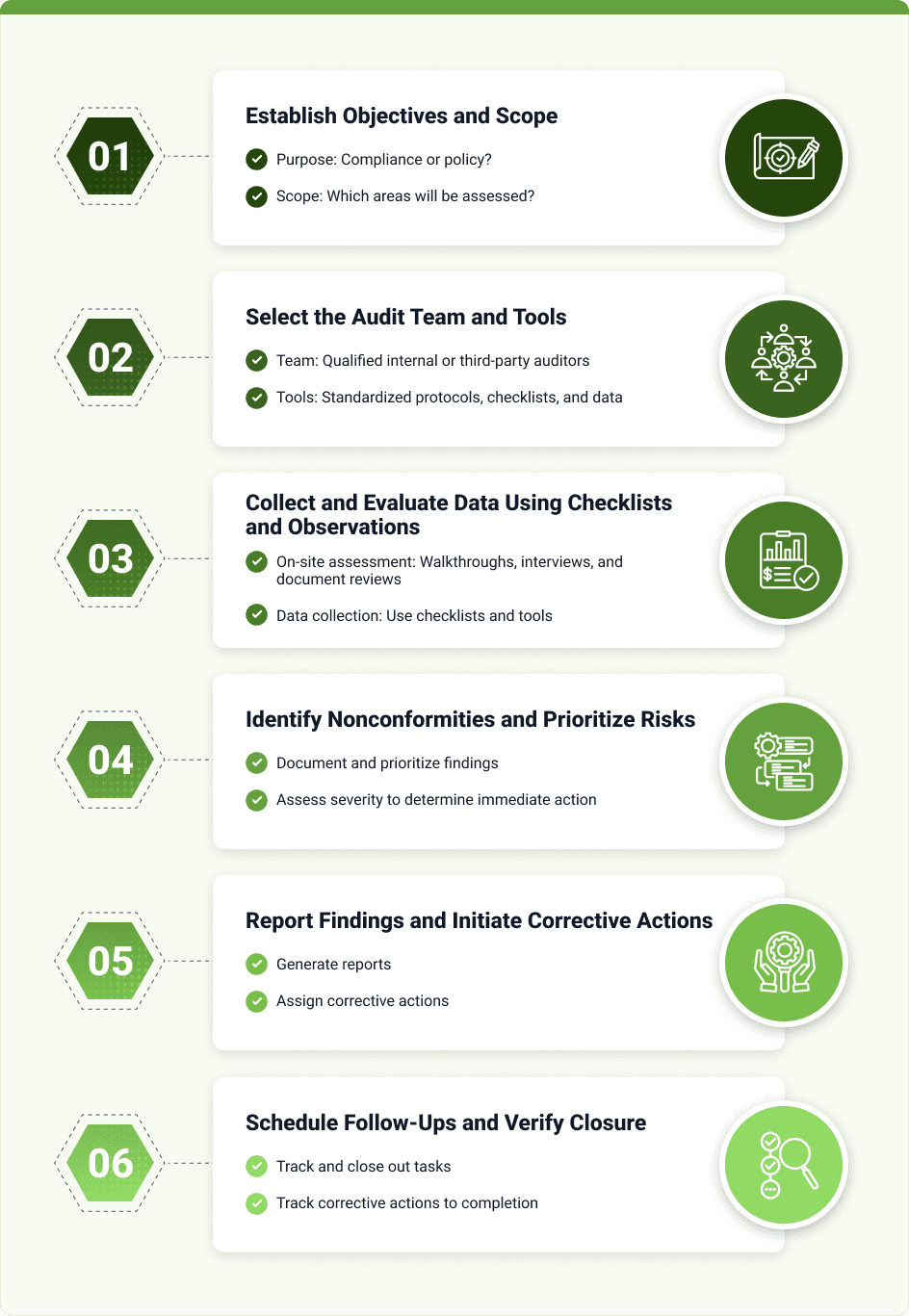 By integrating Auditor for data collection and Tracer for task tracking, Dakota Software closes the loop between identifying compliance gaps and ensuring they’re corrected—enabling a more proactive and accountable safety management system.
Safety Audit Policy: Embedding Audits Into Company Culture
To move beyond compliance checklists and drive lasting improvement, safety audits must be part of a formal policy that’s embedded in the organization’s culture. A clear, well-communicated audit policy not only sets expectations but also ensures alignment, accountability, and continuous improvement across the enterprise.
What a Safety Audit Policy Should Include
| Element | Description |
| Frequency | Define how often audits should occur (e.g., quarterly, annually, or triggered by incidents or regulatory changes). A consistent cadence enables trend analysis. |
| Scope | Outline what areas will be audited—facilities, processes, programs, or compliance topics—and specify whether audits are comprehensive, focused, or follow-up. |
| Responsibility | Clarify who conducts audits (e.g., corporate audit team, site EHS managers, third-party consultants) and who owns follow-up actions to ensure accountability. |
| Response Protocol | Establish procedures for addressing audit findings, including corrective action timelines, documentation standards, and escalation paths for unresolved issues. |
The Importance of Leadership Buy-In and Multi-Site Consistency
Leadership support is critical for audit programs to thrive. When executives model accountability and resource audits appropriately, audits are viewed as an essential safety tool—not a compliance burden. For multi-site organizations, consistency is equally important. Without standardized protocols and tracking mechanisms, audit effectiveness varies widely from one location to the next, creating blind spots and uneven risk exposure.
Dakota’s Auditor and Tracer products work together to ensure that audit policies are applied consistently across all sites:
- Auditor delivers a centralized library of curated audit protocols based on federal, state, and ISO standards. Applicability logic ensures each facility uses the right checklist for its specific operations and jurisdiction—eliminating guesswork and variation.
- Tracer translates audit findings into actionable tasks, automatically assigning owners, deadlines, and status tracking. This provides enterprise-wide visibility into audit responses and ensures consistent execution of corrective actions.
- Audit Results Roll-Up via Dakota’s Insights platform enables corporate leaders to compare performance across sites, identify systemic risks, and drive continuous improvement at scale.
By embedding audit standards into Dakota’s system, organizations can reinforce expectations, streamline execution, and build a culture where audits are seen not as a disruption—but as a vital tool for safety excellence.
A final consideration for embedding audits into company culture is discouraging competition between sites. Audit effectiveness isn’t about who has the fewest findings, but about identifying and addressing the issues that matter most. For example, a missing HazComm program (one major finding) poses greater risk than several minor documentation gaps. By shifting the focus from “finding counts” to true risk reduction, organizations can reinforce the goal of continual improvement across the enterprise.
Safety Audit Training: Preparing Your Team for Success
 An effective audit program begins with well-prepared people. Training your audit team as well as your employees ensures audits are not only thorough but meaningful. Whether your organization uses internal auditors, third-party consultants, or a combination of both, training should go beyond protocols and forms. It should empower team members to recognize risks, document findings accurately, and understand what audit results mean for day-to-day operations.
Core Areas to Cover in Safety Audit Training
- Hazard Recognition
Train employees and auditors to identify unsafe conditions and behaviors across different operational areas. This includes both regulatory noncompliance (e.g., blocked egress routes, uninspected fire extinguishers) and management system failures (e.g., unclear responsibilities, inadequate controls). - Accurate Documentation and Evidence Gathering
Teach team members how to properly record audit observations with clear notes, photos, and supporting documentation. Consistent, fact-based documentation improves the credibility of findings and helps track issues over time. - Interpreting and Acting on Audit Findings
Go beyond checklist completion and train staff to assess severity and understand how findings relate to broader safety or compliance goals. Emphasize careful wording: findings should describe what was observed or note where evidence was not available, rather than stating a regulatory requirement was not met. This approach maintains accuracy, keeps the focus on improvement, and reduces potential liability if records are reviewed externally.
Emphasizing Cross-Functional Participation
Safety audits shouldn’t be conducted in a silo. Encourage involvement from multiple departments, including:
- EHS/Safety: Ensures regulatory and procedural alignment
- Operations: Brings practical, shop-floor insight and ownership of outcomes
- Human Resources: Helps integrate findings into training and culture programs
- Compliance/Legal: Interprets implications for policy, permits, and regulatory exposure
By including diverse stakeholders, your team gains a 360-degree view of risks—and more buy-in to resolve them.
Dakota’s Auditor makes it easy for teams to learn and apply audit procedures with built-in, plain-language checklists and regulatory references. New or rotating team members can quickly get up to speed using standardized tools, while Tracer ensures that findings and corrective actions are tracked in a shared system accessible across departments.
This integrated approach helps cultivate a confident, collaborative audit culture—where every participant understands the “why” behind the process and is empowered to make the workplace safer.
Conclusion
Safety audits aren’t just about identifying what’s wrong—they’re about building what’s right. When conducted thoughtfully and backed by consistent training, clear policies, and the right digital tools, audits become a cornerstone of a proactive safety culture. They bring clarity to complex operations, help close compliance gaps, and empower employees at every level to take ownership of safety outcomes.
Dakota Software’s integrated platform, featuring Auditor for evaluation and Tracer for corrective action management, helps organizations move beyond checklists and into meaningful action. By linking audit results directly to regulatory obligations and corrective tasks, your team can ensure that findings are addressed, documented, and resolved consistently across every location.
A successful audit program doesn’t just protect your people, it protects your organization’s future. And it starts with the commitment to do more than check a box. It starts with building a culture that expects, supports, and rewards safety—every day.
Ready to strengthen your audit process and build a safer workplace? Request a demo to see how Dakota Software can help you transform audits into a foundation for continuous improvement.