
Serious injuries and fatalities (SIFs) are incidents that result in severe injuries or death to individuals in the workplace. These devastating events not only affect workers but also their families, communities, and the reputation of their companies.
Prioritizing workplace safety is essential to prevent SIFs and avoid disasters that can arise when high-risk incidents are not properly controlled.
SIFs are often preventable however, and safety leaders must seek to learn from them and put measures in place to proactively mitigate areas of high risk and SIF potential. Establishing a robust safety program provides a foundation for ongoing SIF prevention and continuous improvement.
What is a SIF?
A SIF event is a workplace incident that results in, or has the potential to result in, a life-altering injury, illness, or death. They typically involve permanent or significant damage to a part of the body, organ function, or otherwise permanently change or disrupt a person’s normal life activity.
These incidents can occur in any workplace and can happen in various ways, such as a worker being struck by a falling object, falling from a height, coming into contact with a hazardous substance, or suffering serious burns due to exposure to a specific hazard like electrical equipment or chemicals. For example, a SIF event could involve a worker experiencing serious burns after an electrical arc flash, where the specific hazard is the high-energy electrical equipment.
Organizations determine whether an incident qualifies as a SIF by evaluating the consequences of the event, such as the severity of injury or potential for fatality. The difference between an accident and a SIF is that while all SIFs are accidents with severe or life-altering outcomes, not all accidents meet the threshold of a SIF, as SIFs are defined by their significant consequences. It is important to measure the impact of SIFs to assess the effectiveness of safety measures and to prioritize risk reduction efforts.
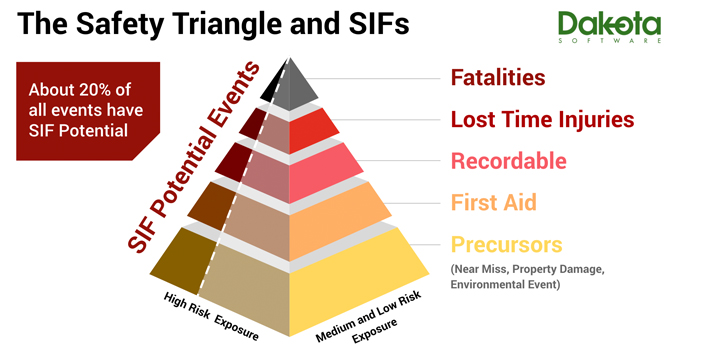
Identifying and classifying SIFs and potential SIFs can be subjective, but these events can provide key learning opportunities for organizations and industries. Near misses and other precursor events can also help identify areas of concern but it’s important to focus on the events with higher risk exposure as to not divert attention from the events with the greatest likelihood of resulting in a serious injury.
Types of SIFs
It’s important to understand the different types of SIFs, as well as the high risk situations that often lead to them, in order to learn from them effectively. Some of the most common types of SIFs include:
- Falls: Falls are a common SIF that can occur in almost any workplace. Workers may fall from heights, slip on wet floors, or trip on objects left on the ground.
- Struck by object: Objects can strike workers, including things falling from heights, flying debris, or vehicles hitting them.
- Caught in/between: Workers can experience this type of SIF when they become caught between two objects, such as a piece of machinery and a wall, or when they become caught in a moving piece of equipment.
- Electrical incidents: Electrical incidents may occur in any workplace with electricity, resulting in electrocution or serious burns.
- Confined space incidents: Workers may experience this type of SIF when working in confined spaces, such as tanks, silos, and sewers. They may suffocate, become exposed to toxic fumes, or get stuck in tight spaces.
- Fire or explosion: Any situation involving an uncontrolled fire or explosion or where an uncontrolled fire or explosion is possible.
- Hazardous Substance Contact: These SIFs involve situations where a biological, chemical, or radiological hazard could be inhaled, ingested, or come into contact with the skin.
It is critical to monitor PSIF incidents—potential serious injury or fatality incidents—because they serve as leading indicators of safety risks in the workplace. These incidents highlight situations where, if safety barriers or countermeasures failed, workers could suffer severe consequences.
Implementing effective countermeasures is essential to protect employees from these critical hazards and to reduce the likelihood or severity of such incidents. Proactively addressing these incidents ensures that the most critical risks are managed and that the workplace remains as safe as possible.
Understanding and Learning from SIFs
Let’s take a closer look at how organizations learn from SIFs and establish a safe state to improve safety outcomes.
Safety leaders can employ various methods to learn from, and reduce the likelihood of, SIFs, contributing to a safe state. These include Root Cause Analysis, Heinrich’s Triangle, the Hierarchy of Controls, and use of a safety management system. The process of analyzing SIF data involves systematically collecting, categorizing, and evaluating incidents to identify trends and underlying causes. Since most organizations don’t have a large number of SIFs, data analysis can be difficult.
Therefore, understanding which events have SIF potential, or are SIF precursors, and categorizing them as such, can yield more opportunities for qualitative analysis and serve as a powerful leading indicator for SIF prevention. Making informed decisions based on SIF data is essential for effective risk management. When control measures are ineffective, hazards remain uncontrolled, increasing the likelihood of serious injuries or fatalities.
To address SIF risks proactively, organizations must implement targeted safety measures before incidents occur. Communication is also critical—sharing lessons learned from SIFs ensures everyone understands safety priorities and contributes to a safer workplace. It is important to act on findings from SIF analysis to continuously improve safety performance.
Of course, these approaches should be combined with proactive programs focused on traditional leading indicators such as inspections, training, and safety observations, and enhanced by technology, to produce quantitative insights and a full picture of safety risk. Let’s start by looking at the qualitative approaches.
Root Cause Analysis
A root cause is an underlying, system-related reason why an incident occurred. A Root Cause Analysis (RCA) is an investigation aimed at understanding what happened, how it happened, why it happened, and what needs to be corrected. Both the Occupational Safety and Health Administration (OSHA) and the Environmental Protection Agency (EPA) encourage organizations to conduct an RCA following an incident or near miss at a facility.
A successful Root Cause Analysis identifies all root causes, as there are often more than one, and should result in corrective actions that eliminate the problem itself, not just the symptoms. It is important to verify that these corrective actions effectively address the identified root causes to ensure long-term resolution.
Taking appropriate action based on RCA findings is a key outcome, as it mitigates hazards and prevents recurrence. The more robust the RCA investigation and corrective/preventive actions implemented, the better workers will be protected in the future. Using RCA on potential, and precursor SIFs, can help to focus on higher risk issues and serve as a proactive method of preventing actual SIFs from occurring.

Heinrich’s Triangle
Heinrich’s Triangle is a well-known model for understanding the relationship between near misses, incidents, and fatalities. The model is common when discussing prevention or serious injury or in some cases, multiple serious injuries.
This model suggests that there are multiple incidents and near-misses for every fatality. Herbert Heinrich developed this theory in the 1930s, and it has been part of health and safety procedures ever since. The pyramid-shaped model shows that for every 300 accidents, there are 300 with no injury, 29 with a minor injury, and one with a significant injury.
Safety leaders can identify patterns and develop strategies to prevent future serious injuries and incidents by studying these incidents and near-misses. According to Heinrich’s theory, by reducing the number of near misses, the number of serious injuries will decrease proportionately. Utilizing this model, safety leaders can proactively prevent SIFs by identifying and addressing potential hazards before they result in a serious injury or fatality.
The model also creates a feedback loop, where continuous monitoring of near misses and incidents informs ongoing safety improvements and hazard mitigation. This is foundational in creating a workplace that mitigates serious injuries occuring.
Hierarchy of Controls
The Hierarchy of Controls is a highly effective tool aimed at preventing serious injury or SIFs, widely used by industry and safety professionals worldwide. This system applies to any organization, regardless of size or industry, and provides a step-by-step approach to managing workplace hazards. The Hierarchy of Controls ranks various risk control measures from most to least effective and organizations apply them accordingly until the hazard is eliminated or reduced to a reasonable level.
What is the Safety Integrity Level?
According to the hierarchy, the most effective way to prevent incidents is to eliminate the threat. If elimination is impossible, the next step is to substitute the hazard with something less hazardous. The other steps in the hierarchy include engineering controls, administrative controls, and Personal Protective Equipment (PPE). Safety functions are implemented as part of engineering and administrative controls to ensure specific hazards are managed effectively. This brings us to the safety integrity level.
The safety integrity level (SIL) is crucial in determining the effectiveness of these controls, as it quantifies the risk reduction capability and reliability of each safety function. The extent to which each control measure reduces risk depends on its position in the hierarchy and its assigned safety integrity level, with higher levels providing greater mitigation.
OSHA requires following the Hierarchy of Controls, i.e., organizations cannot skip immediately to PPE (with the exception of hearing protection wear OSHA allows it) but must consider the viability or other types of controls first, reserving PPE as the last resort.
Human and Organizational Performance
Another approach to learning from SIFs is to use a Human and Organizational Performance (HOP) framework. The HOP framework focuses on understanding how human error and organizational factors contribute to incidents. Users of safety management systems benefit from the HOP framework by gaining insights into how their actions and decisions interact with organizational processes, enabling them to identify risks proactively and improve safety in the workplace.
This framework emphasizes the importance of proactive safety measures, including identifying and addressing latent conditions (e.g., system or organizational weaknesses) before they lead to incidents.
Safety Management Systems
Safety Management Systems (SMS) are an essential tool in the process of preventing a serious injury or fatality. According to the Campbell Institute, SMS best practices are foundational for effective workplace safety and management. The Campbell Institute also suggests that SMS is a systematic approach to managing safety that involves identifying hazards, assessing risks, and implementing controls to prevent incidents.
The power of SMS and modern technology lies in their ability to provide organizations with the tools and data needed to make informed, proactive safety decisions, helping to identify hazards before incidents occur and assisting in avoiding SIFs.
ISO 45001 is a standard for occupational health and safety (OHS) management systems aimed at reducing occupational injuries and diseases, as well as promoting and protecting physical and mental health. The ISO 45001 standard, which replaced OHSAS 18001, has an increased emphasis on process of management commitment, worker involvement, and proactive control of risks.
Leading Indicators and the Role of Technology
Safety leaders can use various technology solutions to proactively identify issues before incidents occur, making technology a valuable tool as part of a process in preventing SIFs. For instance, wearable technology can monitor worker behavior and identify potential hazards, while sensors installed on machinery have the ability to detect hazards such as overtemperature and other unsafe conditions.
This ability to detect hazards enables automated systems to bring process to a safe state, helping to maintain safety integrity and prevent incidents before they escalate.
EHS software can also play a vital role in helping organizations implement process and prevent serious SIFs by providing a centralized platform for managing safety data and identifying potential hazards. Here are some of the key ways that EHS software can help prevent SIFs:
- Incident Reporting and Investigation: EHS software can provide a centralized system for an organization in reporting and investigating incidents. This can help safety leaders to identify the root causes of incidents and take corrective actions to prevent future incidents.
- Hazard Management: EHS software can help safety leaders in an organization to identify potential workplace hazards and take the necessary steps to eliminate or control them. This can include conducting risk assessments, tracking corrective actions, and monitoring hazard controls.
- Training Management: EHS software can help ensure workers of an organization receive proper safety procedures and protocol training. It can manage training records, schedule training sessions, and track compliance to guarantee that workers receive adequate training.
- Auditing and Inspections: EHS software helps safety leaders conduct regular audits and inspections to identify potential hazards and be in compliance with safety regulations. This can include tracking audit results, assigning corrective actions, and monitoring progress.
- Analytics and Reporting: EHS software provides real-time visibility into safety performance metrics, allowing safety leaders to track progress and identify areas for improvement. This can include tracking safety incidents, monitoring safety Key Performance Indicators (KPIs), and generating reports for internal and external stakeholders. Most importantly, safety data explorations tools can help safety and site leaders better understand and learn from their safety data.
Preventing SIFs with Dakota Software
SIFs are avoidable when organizations and safety leaders take proactive measures to create a secure work environment for their employees. Safety leaders can learn from SIFs by conducting a thorough Root Cause Analysis, using a human and organizational performance (HOP) framework, and implementing a safety management system (SMS) to understand their safety risks and manage them proactively. EHS software serves as a crucial instrument for organizations seeking to avert SIFs by offering a unified platform for tracking leading safety indicators, recognizing potential risks, and implementing corrective measures.
Dakota’s solutions help optimize safety management procedures, enhance cooperation among safety teams, and manage EHS compliance with safety regulations. Explore our product demo library to discover how our solutions can help you establish and maintain a safer work environment.