

Environmental hazards are physical, chemical, biological, or social conditions that pose risks to workers, operations, and surrounding communities. They arise from both natural events and human activities.
For Environmental, Health, and Safety (EHS) professionals, managing these risks is a daily operational reality. The difference between a well-run compliance program and an incident or violation often comes down to whether hazards are identified, documented, and addressed before they escalate. Left unmanaged, environmental hazards compound quietly, until they surface as workforce injuries, regulatory citations, or costly liabilities.
Why Environmental Hazard Management Matters
Environmental hazards don’t stop at the facility fence line, and they have a way of becoming compliance problems. A spill becomes a water quality violation. An air quality issue becomes a citation. A tracking failure becomes an audit finding.
Organizations that manage environmental hazards proactively see measurable returns: reduced workplace incident rates, lower insurance exposure, and fewer regulatory surprises. Organizations that manage them reactively face enforcement actions, remediation costs, and the operational disruption that follows.
The regulatory framework reinforces this reality. EPA standards, OSHA requirements, and state environmental regulations establish baseline obligations for identifying and controlling environmental risks. When those obligations are treated as a ceiling rather than a floor, EHS leaders are the ones left explaining what went wrong.
Left unaddressed, these hazards also carry costs that rarely show up in a single line item: rising workers’ compensation claims, higher insurance premiums, and reputational damage that follows an organization into its next customer contract or investor conversation.
Types of Environmental Hazards
Physical Hazards
Physical hazards include noise, radiation, electromagnetic fields, extreme temperatures, and vibration. These are among the most measurable environmental risks and, in many workplaces, among the most commonly under-managed.
Common examples of physical environmental hazards include prolonged noise exposure above OSHA’s permissible limits, which causes cumulative hearing loss and hearing-related injuries, and radiation from industrial or medical equipment, which requires rigorous monitoring and shielding. Heat stress presents growing safety risks as climate conditions intensify operational exposure for outdoor and manufacturing workforces. Other examples include whole-body vibration from heavy equipment and electromagnetic field exposure in high-voltage environments.
Physical hazards don’t only affect workers on site. A neighbor affected by noise, odor, or light from a facility can file a complaint with a regulatory agency, triggering an investigation. Even an unfounded complaint creates regulatory exposure — issues discovered during the investigation can carry substantial penalties regardless of what prompted the inquiry.
One particular aspect of physical hazards is often overlooked – that the impacted person may not even be an employee! A neighbor upset over noise, odor, or light from the facility may file a complaint with a regulatory agency, resulting in an investigation. Even though the original compliant may prove unfounded, issues discovered during the investigation can carry substantial penalties.
Effective management of these environmental hazards starts with accurate exposure monitoring. Without baseline measurements, organizations can’t determine whether controls are working or where resources should be focused.
Mitigation strategies:
- Conduct regular noise, radiation, and temperature monitoring in high-risk work areas
- Implement engineering controls (acoustic enclosures, shielding, ventilation) before defaulting to PPE
- Establish administrative controls that limit exposure duration where elimination isn’t feasible
- Develop procedures for handling nuisance complaints.

Chemical Hazards
Chemical environmental hazards are among the most heavily regulated risks in any industrial setting. Examples include air pollutants, soil and groundwater pollution, hazardous waste, and toxic substances such as lead and asbestos. Additional examples — VOCs released during manufacturing, mercury in industrial processes, and pesticide runoff from agricultural operations — illustrate how broadly chemical risks can affect both worker health and the surrounding environment. The harmful effects of chemical exposure can extend well beyond the facility fence line and affect surrounding communities for years.
Air pollution from industrial emissions is subject to Clean Air Act permitting requirements. Soil and groundwater pollution from hazardous substances triggers CERCLA and RCRA obligations. Asbestos-containing materials in facilities built before 1980 carry ongoing management requirements under AHERA. Lead paint in pre-1978 structures falls under EPA’s RRP rule.
The regulatory burden compounds with age. Older facilities often carry legacy chemical hazards or hazardous building materials that require active management programs, not one-time remediation.
Mitigation strategies:
- Monitor emission levels against permit limits and document compliance continuously
- Maintain compliant hazardous waste storage, labeling, and disposal procedures
- Establish asbestos and lead management plans where applicable, with inspection schedules and worker notification protocols
Biological Hazards
Biological hazards represent environmental health hazards that are often less visible than physical or chemical risks but equally consequential to occupational health and workforce safety. Examples include Legionella bacteria in water systems, mold from moisture intrusion, bloodborne pathogens in healthcare environments, and vector-borne disease risks in outdoor work settings.
Legionella bacteria in cooling towers and hot water systems has caused documented fatalities and carries significant regulatory and liability exposure. Mold growth from moisture intrusion affects both human health and structural integrity. In healthcare settings, infection control failures create patient harm and regulatory risk simultaneously.
The COVID-19 pandemic demonstrated the operational and financial consequences of inadequate biological hazard management at scale, accelerating regulatory scrutiny of ventilation standards, PPE usage, and workforce safety protocols.
Mitigation strategies:
- Implement a Water Management Plan for Legionella risk in regulated facility types
- Address moisture intrusion promptly; remediate mold per IICRC S520 standards
- Maintain HVAC systems and conduct air quality monitoring in buildings with known biological risk factors
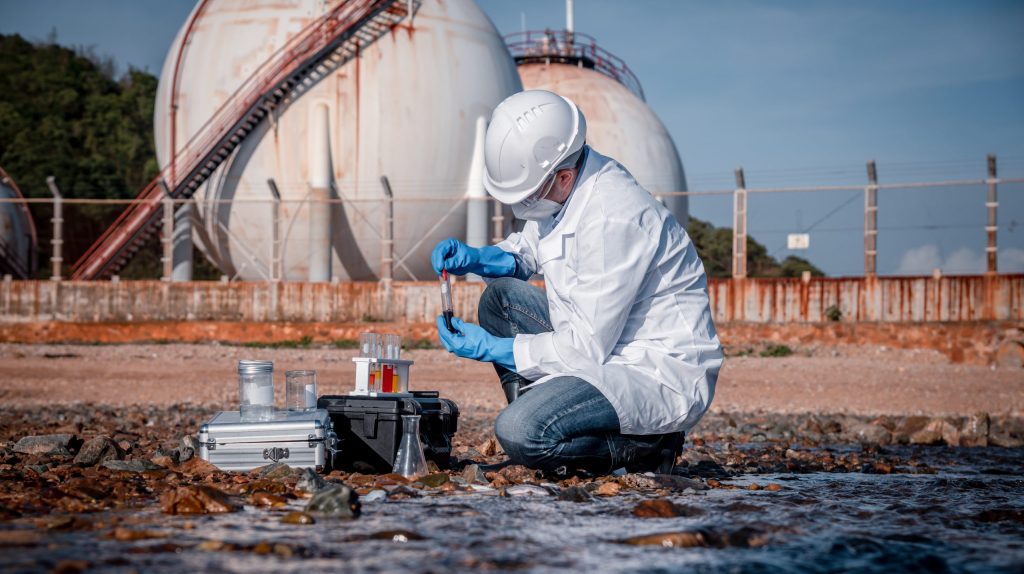
Natural Hazards
Earthquakes, floods, wildfires, and severe weather events are environmental hazards that organizations cannot prevent but must plan for. Beyond direct infrastructure damage, natural disasters can trigger secondary risks — chemical releases, structural failures, and pollution events — that carry their own regulatory consequences.
Climate-related risks are increasingly material to EHS planning. Flood-prone facilities face compounding exposure: property damage, potential pollution releases, and post-event regulatory scrutiny. Wildfire smoke creates air pollution obligations for facilities in affected regions. These are environmental impacts that require specific response protocols, not just general emergency planning.
Mitigation strategies:
- Incorporate natural hazard scenarios into emergency response and business continuity plans
- Conduct site vulnerability risk assessments for flood, seismic, and extreme weather risks
- Establish protocols for secondary environmental hazard response following natural events
Social Hazards
Social hazards, including overcrowding, inadequate infrastructure, and environmental justice concerns, are often the least-modeled category in EHS programs and among the most consequential from a regulatory and reputational standpoint.
EPA’s environmental justice frameworks represent evolving regulatory terrain. Facilities sited near overburdened communities face heightened scrutiny of cumulative environmental impacts, not just individual permit compliance. EHS teams that haven’t assessed their public health impacts are likely underestimating them.
Mitigation strategies:
- Assess facility siting and operational impact through an environmental justice lens
- Engage with community stakeholders proactively, particularly where cumulative environmental issues are a regulatory focus
- Align CSR commitments with environmental hazard reduction priorities

Environmental Risk Assessment: A Practical Framework
Effective management of environmental hazards begins with a structured risk assessment process. The goal isn’t documentation for its own sake. It’s building an accurate, current picture of where risks exist so that resources are directed to the highest-priority areas first.
Step 1: Identify and evaluate hazards
Conduct site-specific environmental risk assessments that account for operations, materials, facility age, and surrounding environmental factors. Visual inspections, environmental sampling (air, water, soil), and worker interviews all contribute to a complete hazard inventory. Historical land use data often reveals legacy chemical hazards and prior pollution events that current operations don’t explain.
Step 2: Monitor, document, and forecast
Real-time monitoring closes the gap between periodic assessments and actual workplace conditions. EHS teams that rely solely on scheduled sampling carry blind spots in their risk picture. Continual monitoring of air pollution levels, water quality, and noise enables faster detection and more defensible documentation.
Step 3: Engage the workforce
Workers in affected areas are frequently the first to observe changing conditions: unusual odors, equipment changes, and health issues that may indicate emerging environmental health hazards. A hazard identification program that doesn’t capture frontline observations is missing material health and safety information.
Step 4: Align with regulatory requirements
Environmental hazard assessment doesn’t happen in a vacuum. OSHA process safety standards, EPA reporting thresholds, state environmental permits, and local ordinances establish what must be assessed, how frequently, and by whom. Building regulatory requirements into the assessment calendar keeps programs defensible and complete.
Step 5: Review, update, and improve
Environmental conditions change. Regulations change. Operations change. Assessment programs that aren’t revisited on a defined cycle accumulate untracked risks without generating a corresponding audit trail. Annual review is a minimum; higher-risk facilities and operations subject to frequent regulatory change warrant more frequent review.
Managing Environmental Hazards with ProActivity
Managing environmental hazards effectively requires more than periodic assessments and paper records. It requires a system that connects regulations to compliance obligations and makes it possible to track both in real time.
Dakota’s ProActivity platform gives EHS teams the regulatory intelligence and workflow infrastructure to manage environmental hazards from identification through resolution. Regulatory content is monitored continuously across federal and state agencies, mapped to your specific operations, and translated into actionable compliance requirements before enforcement deadlines create pressure.
Assessment findings, corrective actions, inspection schedules, and regulatory change notifications are managed in a single system, giving EHS leaders the visibility to make decisions and the documentation to defend them.